
This is the final episode in our Knowledge 2026 coverage series, recorded live in Las Vegas. If you haven’t caught the earlier episodes, we’d suggest starting with our conversations with ServiceNow SVP of global partnerships and channels Michael Park and ServiceNow AVP of Canada Cristin Gooderham – both published last week.
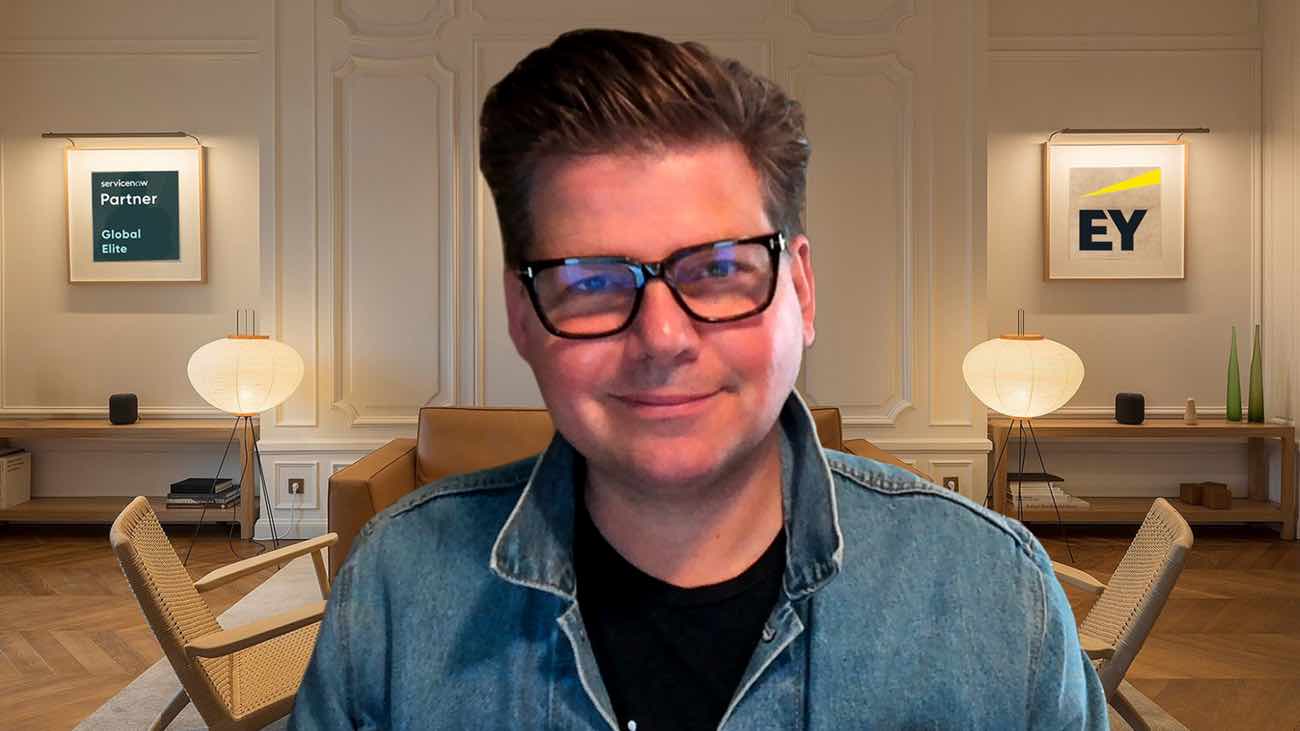
Steven Kiss is a partner at EY Canada and leads the firm’s ServiceNow practice nationally. His path to EY is worth knowing: in 2013 he co-founded SuMO IT Solutions, which grew into Canada’s largest ServiceNow boutique and became the country’s first gold and first elite ServiceNow partner. EY acquired SuMO in May 2021, making this conversation’s recording date – almost exactly five years later – a quietly meaningful one.
EY is a global elite ServiceNow partner and the reigning worldwide partner of the year for banking, risk, and security. Steven’s strength in this conversation is that he speaks as a practitioner, not a spokesperson. He describes EY using ServiceNow internally as client zero – targeting eighty-five to ninety percent deflection of HR interactions, with employees getting instant answers to questions that used to require a chain of emails. He’s watching the agentic AI transition from the inside of a four-hundred-thousand-person organization.
On the practice-building side, his advice is consistent and direct: configuration over customization, accelerators over custom builds, and outcomes over deliverables. The partners who survive the AI transition, he argues, are the ones who learn to translate technology capability into business value – not the ones who can deploy the most modules the fastest.
His closing advice to Canadian MSPs and solution providers is worth the listen on its own: before you talk about what you can build, stop and ask what the client is actually trying to accomplish. It’s the philosophy that built SuMO – and it’s the one he’d hand to any partner trying to figure out where they fit in the agentic business era.
Podcast: Play in new window | Download
Subscribe: Apple Podcasts | Spotify | Amazon Music | Android | iHeartRadio | Youtube Music | RSS
Read Full Transcript
Robert Dutt: Hello and welcome to In The Channel from ChannelBuzz.ca, bringing news and information to the Canadian IT channel community for the last sixteen years. I’m Robert Dutt, editor of ChannelBuzz.ca, and your host for the show.
This episode wraps up our coverage from last week’s ServiceNow Knowledge 2026 conference in Las Vegas. If you’ve been following along, you’ve heard from ServiceNow’s global channel chief on how the partner model is evolving around the Agentic Business, and from ServiceNow’s Canadian leader on what all the big announcements mean for Canadian enterprises and partners specifically. This conversation is a different angle altogether – what does this moment look like from someone who’s actually been building a ServiceNow practice in Canada for over a decade?
My guest is Steven Kiss, partner and national ServiceNow practice leader at EY Canada. What makes this conversation different from a lot of partner-perspective interviews is his backstory. Steven didn’t arrive at EY through the traditional consulting path. In 2013, he co-founded SuMO IT Solutions, which became Canada’s largest ServiceNow boutique – the first gold and first elite partner in the country. EY acquired SuMO in May 2021, and Steven has been running the national ServiceNow practice from inside one of the world’s largest professional services firms ever since. EY is a global elite ServiceNow partner and the reigning worldwide partner of the year in banking, risk, and security.
That combination – born in a boutique, operating at GSI scale, winning in regulated verticals – gives him a perspective on where the channel is headed that’s worth hearing whether you’re running a five-person shop or a fifty-person one.
Let’s get right into it – my chat with Steven Kiss.
Steven, thanks for taking the time. I appreciate it.
Steven Kiss: My pleasure, Rob. Good to be here.
Robert Dutt: I want to start off with a little bit of the background. You didn’t arrive at EY through the traditional consulting angle. It’s neat that you built out a ServiceNow specialist in SuMO IT, which was then acquired. For listeners who don’t know the backstory, can you give us the elevator pitch version of what happened? And also, what does the EY ServiceNow footprint in Canada look like today?
Steven Kiss: Yeah, absolutely. I’d love to tell you that story. It goes back to 2013, where we saw an obvious opening in the market. ServiceNow was coming on strong, really starting its momentum. We had a lot of legacy HP folks and HP Service Manager, et cetera. With ServiceNow, I think there was a real opportunity to see the market redefine and reshape itself. We launched in October 2013 with just a handful of employees, and really being focused on the goal of building the best service management partner organization in the country – that was the fuel that allowed us to grow. It wasn’t about how do we grow the quickest, have the most people, have the most certifications, be the most profitable. We really just wanted to be the place that people would come to when they wanted to modernize and accelerate their transformation. And then it grew into, I would say, Canada’s largest ServiceNow boutique. We were the first gold partner in the country, and then we became the first elite partner in the country. Then up to the point in May 2021 – which is our fifth anniversary coming up in a couple of days – we completed the acquisition by EY, where we brought 85 professionals into the EY Canada organization. That’s just the high-level story.
Robert Dutt: That’s the backstory. Where’s that business at now? What does it look like in terms of scope and scale?
Steven Kiss: It’s been an incredible ride. We brought in the things that made the boutique partner super successful, which meant very deep technical skills, then expanding as the ServiceNow platform expanded. But there’s a true opportunity within an organization like EY to leverage that front-end consulting engine. EY as a legacy consulting organization is in the market every day talking about HR, cyber risk, supply chain optimization, any part of the business. What that offered them was the ability to operationalize consulting – in the real world, solve the problem for the customer by using technology. We’ve been able to grow with that through activation and integration within the firm. It’s been an incredible ride and it still continues to grow and expand today. Significant growth over the past five years.
Robert Dutt: The big theme here was obviously the Agentic Business – the argument that the pilot era is over and we’re moving towards autonomous AI deployment that shows real value. From where you sit, working with Canadian enterprises day to day, how does that land with what you’re seeing, with where people are? Are your clients there yet, or is this still aspirational for most?
Steven Kiss: Well, I think let’s put it this way. I think people have a sense of what they’d like to accomplish when we talk about the agentic enterprise – the vision of the future, the aspirational vision of tomorrow. I think that’s somewhat clear in people’s minds. It may not be fully aligned from executive to executive across the board, but I think they have an aspirational thought of what it is. A couple of years ago, Gartner put out a quote – and I hate to misquote it – but something along the lines of the vast adoption of AI in an enterprise will come from the platforms people are already using. And of course, we’ve seen that: ServiceNow, who’s been in the AI space for years and years, and other platforms that enterprises trust are obviously incorporating AI capabilities. You’ve got departmental efficiencies in a lot of cases, but I don’t think you have the end-to-end benefit of AI all the way through. You’ve got pockets of it, but the enterprise benefits are not yet being realized.
A hundred percent, like everybody says, we’re in the pilots and the kicking of the tires phase. But I think we have to think broader. This is not about how do I get my department to operate better, faster, stronger, cheaper – it’s really about the execution from request all the way through to fulfillment across the enterprise. We have the same actual goals as what we’ve had for years: breaking down silos, creating efficiencies across the enterprise, now with an expectation of accelerating all that. The good news is it’s at least a familiar challenge – a familiar motion – to break down those silos and get everyone rowing in the same direction.
Robert Dutt: A hundred percent. And I think that’s exactly it. How do you see your role, or the role of other partners, in helping organizations get that alignment across executives and get everyone prioritizing and identifying the steps?
Steven Kiss: Yeah, this is very interesting. This is where I look back on the earlier question about boutique versus the Big Four mindset now. I think of us very much along these lines. I’ve seen from the inside what organizations like EY have done. We’re a global operation – four hundred thousand people. Yes, we look at it from the Canadian lens because of being in Canada, but we’ve seen firsthand how these pockets of AI innovation turn into more enterprise workflows. Again, we’re four hundred thousand people, so any time we can see even single-digit efficiencies, that adds up to real dollars – and more importantly, less frustration for the people inside these workflows. We’re able to take these case studies and things that we’ve seen as client zero to our clients. We go, “Look, we are also a global operation. We have global employees. We understand the frictions from the inside.”
And I think being able to tap into that front-end consulting engine I mentioned a few moments ago – we are already in the market talking to the people who own that business problem, the person who feels the pain of it, potentially the budget to solve it. We’re able to bring our expertise to that story and explain how we would solve that problem. I think the adoption of platforms like ServiceNow reduces the obstacles to get there, simply because we can leverage the “using technology you already own” mindset. You don’t have to buy yet again another tool, another platform, train more people. It’s already been security vetted. You already know how to support it. Your people are used to using it. Why not simply extend it into these areas? That’s been a huge benefit of the conversations we’re having.
Robert Dutt: A big theme here – and whether you want to call it eating your own dog food or drinking your own champagne, ServiceNow tends to call it “Now on Now,” running the business on the product – I’m curious how you guys use ServiceNow internally, and especially as some of the new agentic capabilities roll in, how you’re thinking about it from an internal lens as a way to both learn and to add value to the organization.
Steven Kiss: Yeah, absolutely. It continues the thought from before – AI, obviously, is going into every department. There isn’t a department that’s not looking at it. We’re doing the exact same thing internally. We are a client of ServiceNow in addition to being a global elite partner, and we have the luxury of being able to look at it from the point of view of scale. Initially people are looking at it from the departments that are – I don’t want to necessarily say early adopters, but potentially early adopters – and IT would be one. If you think about what happened a generation ago with IT service management moving into enterprise service management, it’s the exact same thing. IT is one of the most framework-driven departments in an organization. We ourselves have deployed ServiceNow in IT for request management, traditional help desk support, ticketing, case summarization – things of that nature have been huge. HR has also been a huge accelerated adoption area with ServiceNow – onboarding new employees and things of that nature.
We also see ourselves moving very aggressively toward the target outcome of deflecting eighty-five to ninety percent of HR interactions. Things as basic as “What is the value of my flex benefit account?” or “How many days of vacation do I have?” – these are all things that the human in us wants to know nearly every day, but getting to that answer is not as easy as it should be. I have to send an email and I have to hope I get an answer. Now I can just simply ask and get the answer back. Looking at the employee from the human nature element is guiding where we’re taking it next. It’s really exciting where I’ve seen EY go from five years ago to today, and I think we’re going to see further acceleration in these areas.
Robert Dutt: You guys just won Worldwide Partner of the Year for banking and risk. Very specific distinction – not just great implementation partner, but specifically in high-stakes, regulated space. Take your victory lap. What does that actually mean in terms of what you think you’re doing that more generalist partners aren’t?
Steven Kiss: It’s incredible. And Rob, I hate to point it out – you also missed security in there. So it’s risk, security, and banking, which means we’re on the resilience side. If I take risk and security together, it’s not functional deployments of these things – it’s understanding the mindset of what resilience means to organizations, especially regulated industries like banking. This is a perfect example where these things actually come together.
I think what separates us, in addition to the obvious large footprint in the banking and financial services sector to begin with, is again leveraging that front-end consulting engine. It’s one of our largest sectors. It’s where we’ve got a ton of innovation going, especially internally at EY with our AI innovation centers, et cetera. There’s a lot of horsepower and investment directed at these. I think they’re also the sectors that are investing the most themselves. So there’s a very strong partnership. It’s truly amazing for us. We work with very large financial institutions to help them get to success in these areas.
I think it’s also not about deployment of modules. It’s not about people at hours. It’s really about outcomes and value – being able to really understand our clients, understand their business, understand their greatest challenges, connecting those issues across levels in the organization so we can understand what success looks like for them. We also have banking innovation departments with people who spend all day, every day just thinking about what the future of banking looks like. Being able to apply the value proposition of the ServiceNow alliance as part of those conversations is a huge differentiator. And this is the third year that we are the banking partner of the year, so we see continued success there.
Robert Dutt: Close to home – I keep thinking about regulated industries in Canada, data sovereignty, public sector sensitivity, OSFI E-21, all of these things. Given that you guys have practice strength in exactly those regulated environments, where do you see the biggest near-term deployment opportunities for ServiceNow in Canada specifically? And what do you see as the blockers that are still there?
Steven Kiss: Yeah, absolutely. I’ll start with blockers. I think organizations need to realize that they’ve got to get their data in order. This is the foundational element that’s going to stop rapid deployment if they don’t have it in place. They’re just going to be behind – and I don’t think the market is going to tolerate falling behind. The people who are proactive at investing in what tomorrow is going to look like will be the winners from a business perspective. That’s foundationally it.
When you start talking about OSFI E-21 and regulation, they’re very defined on what the needs are, but I don’t think those needs are defined fully – we can’t see so many years out. They will constantly evolve, because we ourselves don’t ultimately know what AI is going to look like. So how would the regulations? They’re going to constantly evolve and mature. And I think the benefit of what I’ve seen in platforms like ServiceNow is the endless ability to evolve with the times without ripping and replacing. The investments will be leveraged and built upon and refined. I haven’t seen any other organization plow as much R&D into their platform as ServiceNow has. It’s not build your own house. They’ve defined it and created the frameworks, and configuration – not customization – is going to get us where we need to go. That’s a huge differentiator. But again, it’s ultimately going to come down to navigating the endless evolution of these regulatory needs.
Robert Dutt: One of the big announcements this week – Action Fabric and the MCP integration layer – opens the door for partners to build proprietary IP on top of the platform and bring it to market as their own. Curious how you’re thinking about that. Is that something you’re doing – building reusable accelerators or industry-specific agents that you’re bringing to clients? And how do you think about the build-versus-configure question as that evolves?
Steven Kiss: Yeah. I’ll start at the end and you can keep me on the straight and narrow with the rest of the question. With clients, it’s very much about having a framework of success as you start to deploy. And as I said previously – configuration, not customization. Leveraging as much out of the box as possible, and industry-leading practices are going to drive how we deploy things. This is not about individual whims. There is a well-worn path in front of you – follow it, adapt around it, and then you are going to be running, not walking. The organizations that adapt and create that framework of success are going to be the very successful ones.
As it relates to building blocks to create IP at the partner level on top of the platform – I think we’ve seen this for years with different degrees of success – because you’re essentially thinking about it from a productizing perspective. You have to accept the fact that if you are in the productized business, you are a product organization. You need size, scale, ongoing investment. You have to have that commitment internally.
I’m a big fan of innovation where it doesn’t ratchet down the foundational capabilities of the platform. I’m a big supporter of accelerators that allow clients to get to the finish line faster – and these don’t necessarily mean we’re creating a product that locks clients into certain capabilities, because we’ve seen the negative side of that over the past five, seven, ten years. Accelerators that provide an industry-leading process to the conversation, that allow us to move the client toward the outcome of what this thing should look like – those are very positive. And once again, if you think about EY, the brand is very strong in risk, security, the resilience story. Partnering with an organization known for that just accelerates the path to the finish line.
Robert Dutt: Outside of what we’ve already talked about – or even within it – what have been your big takeaways from the event? What caught your ear the most and changed the way you think about something, or that you think is going to lead you to do something new or different in the practice once you get back home?
Steven Kiss: The show, a hundred percent. A couple of things. First of all, the way ServiceNow is actually driving the market forward. In some ways it’s very Apple-esque – the old Steve Jobs quote, “our customers don’t tell us what they need, we’re there to help guide them.” I’ve seen that with things like AI Control Tower. Everybody’s excited about the possibilities of AI, but we can’t just let it loose. It has to be governed. And we have to be able to, over our Monday morning lattes, look at a single system and understand where our position of risk is.
Number two – the areas of regulated industries and having a recommended path forward for clients operating in those sectors, being able to guide them through that in an accelerated way so we’re not waiting years to get there. Organizations are looking at this like an arms race – everyone’s running. So let’s make sure they don’t trip and get them there. Those are probably the areas where I’m the most excited about continuing to see the innovation and investment from ServiceNow. It’s something that I don’t think has ever been seen at that level. The way they’ve adapted to the AI story has been incredibly impressive – not following, very much leading. And I think it’s just very exciting.
Robert Dutt: Last one for me. Our audience is primarily VARs, MSPs, smaller solution providers – not GSIs, but folks who are watching what you guys at the big integrators are doing because it tells them something about where the market’s going. Especially given your former life leading SuMO and being in that boutique partner role – if you were advising a mid-sized MSP or other partner right now, who’s trying to figure out their AI strategy and where ServiceNow might fit within it, what would be the most important thing you’d tell them?
Steven Kiss: I think at the end of the day, a laser focus on the client and what success looks like for them. This is not about the technology – the technology is the enabler to get to success. Our secret sauce as we were building our boutique was really to say: yes, you come to us and ask us, “Hey, we want to deploy a module, we want to do this thing, we need a couple of people that are skilled at this.” I would always stop and say that’s great, we would love to have that conversation – but before we get there, what is it you’re trying to accomplish? Who in your organization benefits – customers, employees, vendors, partners? Tell me how it’s done today and tell me what you think it’s going to look like tomorrow. That’s going to be the best way we can advise you and get you there, because we want to be part of your success and create a long-term partnership.
This is not about having more certifications than you do as a differentiator. This is not about being able to code quicker. It’s really about understanding what success looks like. Yes, you make yourself successful because you understand how to deploy – and the functional component of that is selling a deliverable, people, hours. But unless you’re able to translate that into outcomes and value, and articulate the problem that this solves, there’s no way you’re going to justify budget for the next thing you’re trying to do. If you simply focus on the functional execution part and not the business side of it, you will be left behind. You have to constantly think about that. It can be exhausting sometimes, especially for partners that are more technology-driven and not business or consulting-driven. That is a comfort zone you have to get out of. And I think if you do that, you’ll find it’s a very refreshing way to guide your organization through these next steps.
Robert Dutt: That’s great advice. And I think we’re seeing a lot of momentum towards partners being encouraged to think that way. So I appreciate it being amplified. Steven, thanks for taking the time once again. Hope the rest of the show goes well for you.
Steven Kiss: Thank you very much. I appreciate it. Thank you for the time as well.
Robert Dutt: There you have it – Steven Kiss, partner and national ServiceNow practice leader at EY Canada, recorded live at Knowledge 2026 in Las Vegas.
I’d like to thank Steven for his time – and for being one of the more candid guests we’ve had on this show about what it actually takes to build and sustain a practice in this market.
And thank you for listening. Three things from this conversation worth sitting with.
First – EY as its own test lab. The detail that stuck with me most wasn’t about client work. It was Steven describing what EY is doing internally with ServiceNow – targeting eighty-five to ninety percent deflection of HR interactions, so that a question like “what’s the value of my flex benefit account?” or “how many vacation days do I have?” gets answered instantly rather than through a chain of emails. That’s a four-hundred-thousand-person organization using itself as client zero. When he talks about AI adoption in enterprises, he’s talking about something he’s watching from the inside. That credibility comes through.
Second – configuration, not customization. Steven returned to this idea more than once, and it’s worth repeating. His argument is that the partners who try to build elaborate custom solutions on top of the ServiceNow platform are going to get left behind by the partners who master what’s already there, build accelerators that help clients move faster, and focus relentlessly on business outcomes rather than technical deliverables. It’s a discipline that’s easier to say than to build into a practice culture.
And third – the advice he’d give any mid-sized MSP or solution provider right now. It comes straight from the SuMO playbook. Before you talk about what you can build or deploy, stop and ask the client what they’re actually trying to accomplish. Who benefits? How does it work today? What does tomorrow look like? That’s not a sales technique – it’s an operating philosophy. And it’s the thing he says separates partners who justify the next engagement from partners who get left behind.
That wraps up our Knowledge 2026 coverage series. Thanks for spending the week with us in Las Vegas.
If you’re finding In The Channel useful, we’d love for you to follow or subscribe wherever you’re listening. We’re on Apple Podcasts, Spotify, YouTube, and most major directories. Ratings and reviews are always appreciated and always read.
Until next time, I’m Robert Dutt for ChannelBuzz.ca, and I’ll see you in the channel.


